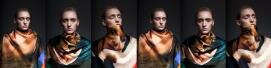
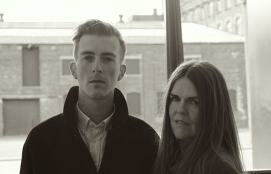
Here is a designer who really focuses on the unseen aspect of design, from researching a concept for a collection to sourcing the best materials that fit his ideas, to using the best factories to construct the garments. Having organically found his place in the market, this is defined by Leder's modest personality which shows through every aspect of the clothing he makes. What excites me about the label and the Spring/Summer 2012 collection is Leder's ability to reference, while maintaining his own identity. I caught up with Leder to discuss his own philosophy, the Galicia theme for this season and his vision for the label to Berlin.
James Oliver: Can you tell me a bit about your childhood?
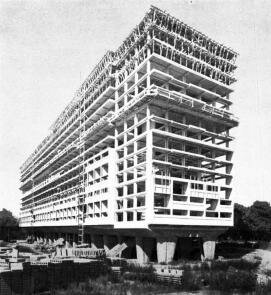
Frank Leder: I Grew up in the Bavarian town of Nuremberg, a beautiful city with a medieval city centre. A lot of buildings had been destroyed in the second world war, although rebuilt so Nuremberg looks like the perfect German picture book town it used to be. My father worked as an architect at that time, so he always took me around when new buildings were being built or when he was working on a new project for some clients. He also was very keen on river fishing, so once in a while we would start really early in the morning and when the sun came up we had already caught a few carp or trout. My father has lost his own father in the war when he was still a child, my grandfather was part of the Czech resistance and was subsequently killed by the German occupants with a bomb in a train compartment in Albania. Without having a father himself he wanted to be a good father to his son, making sure I got exposed to a lot of visual and creative input, visiting exhibitions, meeting interesting people or just roaming the countryside for the perfect mushroom.
JO: What made you want to become a designer?
FL: To create and follow an abstract idea through so it becomes a working and functioning form, this was an early thought I had. I decided not to follow the path of my father as an architect, architecture always struck me as something to elite, only available to wealthy clients and therefore was a limited field. It also would take too long for an idea which had been put down on paper to become reality. I was thinking about studying art, but realised the same problem as architecture, only a very limited amount of people could actually own a piece of work from your output. Fashion instead, has always had the appeal to reach out to a wider audience. In fashion you have to push yourself to create a whole and sound collection every six months. I was never really to keen on showing my clothes in a usual environment, like a trade show or runway presentation. What I set out to do, was to create my very own universe in both a visual style and also in terms of the materials, cuts and detail of my garments.
JO: What were some of your early inspirations when it came to fashion?
FL: I see my interest in fashion more like a wholesome affair. To ask when I first got interested in fashion means to ask when I first started being interested in art, culture or literature. To me those topics are all linked and have to be seen as a whole. My body of work incorporates fashion, although doesn't necessarily limit itself to that. Fashion design for me is a concise expression of my ideas, a natural evolving path which can and should lead to unexpected territories.
JO: Can you explain in detail, the philosophy of your approach and your label?
FL: To enlightening dark, not previously visited corners and niches of my habitat and design world, but keeping in context with my design language and style is a very important part when I sit down and start designing a new collection. I can find inspiration by turning back the clock to take a twist on cultural history with a modern approach and goal in mind. I often try to explore groups of men, their rituals and habits, their codes and hierarchies in my collections. Through my interest in art and literature I was looking for another way to tell a story, to create a world I wanted to share and communicate to people. This path led to fashion design, as I was able to tell an ongoing story not through words, but through garments and pictures created with those garments. Through fashion design I found a way of telling those stories and in addition to that being able to support those tales through my choice of fabrics, design details and collection themes.
Research and designing never stops or limits itself to certain times. I can be in the middle of production of a new collection, but when there comes the moment when something is so strong and wants to tell a story, I am there to take that idea on board and start to weave it into my context of work immediately. The important think is that you have to allow yourself to always be open to new ideas and ways of thinking and perceiving, then ideas can easily settle into your given context.
JO: Can you tell me a bit about the Spring/Summer 2012 Collection and concept for the season?
FL: The Spring/Summer 2012 Collection is a direct follow up on the Autumn/Winter 2011 Collection. Last season introduced the inhabitants of Galicia, giving my customers a feel of this lost land and its' people. This season's theme focuses on the emigration out of Galicia, the travel from the Russian borders with coach and train through Poland and Prussia to the German harbor cities of Hamburg and Bremen and from there the travel will ship to America. Galicia was a very poor place to live around the 1890's, hundreds of thousands of Galician people left for a better life in America or at least they hoped so. From the big harbour cities of Hamburg and Bremen, salesmen employed by the big shipping companies traveled to Galictia to make advertisements for a new life in America, sold tickets and organised the travel to the harbours. A lot of young men avoided military service in the Austrian and Hungarian military by escaping to America.
So the Spring/Summer 2012 Collection is all about leaving your homeland and traveling to an unknown country, one you have just heard of and imagined in your dreams and fantasies. Last season we had sewn vintage bank notes from that period of time into the garments, which by the way was a common way to keep your belongings safe, this time we have searched and found old train tickets and telegrams which we have put into the pockets of some of the specific styles of trousers and jacket to stay in line with our story of travel and dislocation.
JO: How has the brand evolved since you first began?
FL: It was very important to me to build a fundament and has slowly grown from there. In the beginning, I had to find factories in Germany which agreed to make garments to my specific ideas. It was a learning process for both parties, it was basically telling the factories how we liked our garments to be finished. As time went by, an understanding of the details and specifications was established and now we are working hand in hand to archive the production of our collections and it is going well. To grow slow and steady and therefore never loose the quality and craftsmanship out of sight was very important for me. I never wanted to grow fast, rather I wanted to establish a creative and visual universe which people can appreciate and can get excited about, supported by well made and crafted garments.
JO: What direction do you want to take the label in the short and long term future?
FL: I am in the lucky position that I have built a network of friends and contacts all over Germany and Austria, who supply me with craftsmanship, interesting fabrics, vintage buttons and ideas for my new collections. To be able to work as a team every day with people I love and respect, to build up a collection from abstract ideas and to see it evolve and end up as a collection everybody can be proud of is something very special and rewarding and is worth all the hard work every time.
In Germany, which is rich in cultural and industrial background, there are so many different aspects both in terms of work clothing, military surplus and artistic creation to be discovered, which is truly unique and very special. For every collection I try to shed light on a different corner of German culture and tradition, weave a story and build up a collection on it. My approach does not necessarily limit itself to garments and clothing, but ventures out in different fields of creative output like designing furniture and adding different products to my body of work which is in tune with my philosophy and aesthetic.
JO: How does travel effect your approach? Where is the best place you have visited?
FL: Travelling is very important to open your mind. Seeing new landscapes, understanding new cultures and meeting interesting people who have strong characters and have something to say and share is essential for getting input for new collections and projects. It does not necessarily mean to travel far away, sometimes the best input comes from day trips to the countryside or on the way, when I visit my factories or specialist people. Germany is so versatile, when it comes to different areas, between the mountains in South Germans to the coast of Northern Germany, there are many interesting places with history and stories to tell. I feed on these environments, always trying to discover new things I can share with my customers, be it worksmanship from local craftsman, which I can incorporate into my collections, stores from different places which I can build the idea of a collection from or just visual images I can use as a background for the shooting of my collection.
JO: Whats the best thing about where you live?
FL: Berlin is full of history, people and stories, it is just up to me to collect and shape them into collections. The city has seen so many different people who leave their mark, it is oozing with energy and cultural diversity. As Berlin lies in the middle of the European continent, reaching out and discovering other parts of Europe is very easy and is holding great potential for future ideas and concepts.
JO: Whats the worst thing about where you live?
FL: If I would get tired of the place I am living, I would pack my bags and move on...
James Oliver
end