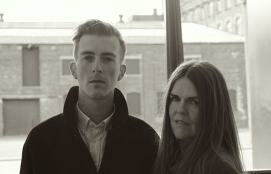
Studio Formafantasma are Andrea Trimarchi and Simone Farresin, two Italian designers based in Eindhoven, The Netherlands. The collaboration between the two started with illustrating books and magazines during their BA in communication design - a partnership that continued to flourish while the pair developed an eye for product design on the IM masters course at Design Academy Eindhoven, where they graduated in July 2009 with a thesis based on traditional Sicilian folk craft. Formafantasma is a continuation of this interest in traditional ideologies; taking the relationship between tradition and local culture and developing it in new ways, whilst paying close attention to sustainability and the significance of objects as cultural conduits.
Recently, Formafantasma were invited to participate in FENDI's Design Performances program - a challenge they took up with a project called Craftica. This project saw the studio create a new and exciting body of work that includes furniture, tools, lighting and water containers, made using discarded FENDI materials. The studio's affinity for environmentalism informs the work, with the objects a reminder of the importance and value of recyclables, whilst at the same time existing as functional and beautiful pieces of art. With Trimarchi and Farresin moving on to their next project, POST NEW managed to pin down the busy pair for a quick conversation on their ideology, research and practice.
POST NEW: How would you describe Studio Formafantasma?
Studio Formafantasma: A Design Studio who likes to wonder.
PN: Tell us about your creative backgrounds prior to forming Formafantasma.
SF: Well we first met in Florence where we studied Design at ISIA. There we ended up more working with communication design even if our main interest has always been product oriented. We decide to apply as a team at the master course at the Design Academy in Eindhoven. That has been the most fundamental educational experience we had.
PN: Your studio is based in Eindhoven, but you both hail from Italy. How does Italian culture and tradition influence your work?
SF: Sometimes it is difficult to be self analytical when talking about your own culture. The fact we are now living in Eindhoven has created the right condition to be more reflective towards Italy and Italian culture. Despite this we actually are not sure in which way Italian culture is influencing our work.
PN: Your work maintains a critical approach to sustainability and explores a close relationship with local cultures and traditions. Why are these things important to your design sensibility?
SF: We think this two elements are important not only for our design sensibility but generally for a contemporary way of living. We all know how fundamental it is nowadays to invest in sustainability and despite we enjoy a lot of results of globalization, we know how diversity is a value. The idea of international style has never been so outdated as now.
PN: You were recently invited to participate in FENDI's Craftica project, where you were to use discarded FENDI materials. Can you expand on your involvement in this project?
SF: We have been approached by Fendi via the team of Design Miami/Basel. As you probably know, Fendi since 2009 is yearly presenting a design project in collaboration with Design Miami. Fendi is really much interested in collaborating with designers with an experimental attitude: we have been asked to use their discarded leather as the foundation of the collection. No others restrictions were imposed.
Fendi is a special partner to work with. In these days the word ‘craft’ is more and more used as a marketing tool. In their case instead craft is genuinely at the core of what they do. It has been inspiring to visit their production companies in Florence and collaborate for certain phases of production with the craftsmen there.
PN: Some amazing materials were used for Craftica - vegetal tanned fish skin for instance (among other natural and animal products). When you're first conceiving of a design like this, are you actively searching for these unique materials or do the materials hold unique properties that lend themselves to the construction/design?
SF: Actually we are never looking for the unique. In a way the project is almost about the opposite. With leather the natural colors and the original textures of the skins are often lost due to an excess of processing. Often rare skins are considered more precious and beautiful. With the project we wanted to discard some of this prejudices.
Despite the pieces appearing exotic in texture and material combinations, the majority of the leather and material used belongs to the daily. The skins are tanned to maintain their original colors and textures and in most cases obtained from common, 'unsophisticated' animals like salmons, trout and pigs. The leathers have been paired with marble, oxidized metal, glass, wood and other unprocessed natural materials such as bones, shells and a sponge cultivated in a sea-farm as a substitute for industrial foam.
PN: Can you name a favourite project to date?
SF: This question is soo difficult! At the moment we are really proud of Craftica!
PN: Do Studio Formafantasma have any exciting new projects planned for the near future?
SF: We do! We are working on some industrial produced pieces with some Italian companies and continuing a research on lava as a material in the surrounding areas of Mount Etna in Sicily.
All images from Craftica by Studio Formafantasma
Jack Smylie
end